



PROCEDURE
This story begins at 10 PM the previous day: it is evening and a large airtight jar containing a soft, whitish mass sits on the table. It is the sourdough starter that Merlini has been cultivating and guarding with passion for a very, very long time
The sourdough starter we will use, in fact, is alive thanks to a series of three daily refreshments – at 10 AM, 2 PM, and one last time at 6 PM – and will be used to prepare a biga – made of 1 kg of Molino Naldoni type 2 Sciòre flour, 470 g of water at 20°C, and 100 g of starter – which we will then leave to mature for 10–12 hours at 20°C.
– 8 AM: it is morning and time to knead.
The recipe requires a dough with barley spent grains and cracked wheat. We will add the spent grains – the residue of malted cereal after brewing – to:
- 650 g of water at 20°C
- 850 g of type 2 “Sciòre” flour
- 300 g of well-drained barley spent grains
- 300 g of mature biga
- 23 g of fine salt
In the mixer, we will pour the flour, combining it with the spent grains, then we will let it work for about 3 minutes. We will then add most of the water and as soon as the mass takes on body and consistency, we will also add the biga in small pieces and let it knead for another 3 minutes, adding a little more water and the salt. We will then let the mixer work for a few minutes, adding water until a medium-bodied consistency is obtained.
We will then let it develop a good gluten structure, then place the dough in a leavening box and cover it so that it does not dry out.
After 20 minutes, we will fold it like a handkerchief, then leave it covered for another 20 minutes before performing a second round of folds and, after another 20 minutes, a third round; we will then wait another 20 minutes and proceed to portion the mass into 260–270g pieces which we will shape into balls, taking care to press and roll them in a bowl of cracked wheat so as to coat the part that will form the crust.
We will then put them back in the box and leave to rise for 3 hours at 20°C, keeping in mind that water and maturation temperatures may vary depending on the climate: higher temperatures are required in winter and cooler ones in summer; in any case, the temperature of the dough coming out of the mixer must not exceed 24°C.
– 1 PM: processing.
We will gently flatten the balls on plenty of flour and place them in 21 cm aluminum pans drizzled with a little extra virgin olive oil, then we will place them back under cover for the final leavening cycle.
– Afternoon: we prepare the ingredients for the garnish
We will rinse some Apulian burratas under a trickle of cold water (preferably in the 300 g format where the inner part prevails), hand-cut them into cubes of 1–3 cm per side, and place them in the refrigerator.
We will then open a can of peeled tomatoes and pour them into a colander over a bowl so as to collect the liquid part, still seedless, in a tray. We will roughly chop the peeled tomatoes and put them to drain in a second colander, discarding any green parts, seeds, and skins.
After about 30 minutes, the tomatoes will be well-drained: we will pour them into a tray, weigh them, and finally, season with 8 g/kg of sea salt, then place them in the refrigerator to keep cool.
We will gather the aromatic herbs on the cutting board – thyme, marjoram, a little chive, and a few mint leaves –, chop them, and add a few spoonfuls of extra virgin olive oil to form a sort of semi-liquid pesto, which we will keep in the refrigerator until service.
– Evening: cooking and garnishing
We will heat the peeled tomato pulp in a bain-marie and slice the Scalogno Nero di Romagna (Black Shallot of Romagna), then gently spread a thin layer of the liquid tomato collected from the first draining over the pizza base and bake at 290°C (50% bottom and 60% top) for about 10 minutes.
When cooked, we will remove the pizza from the pan and, on a wooden cutting board, with a bread knife, we will cut (without pressing!) eight slices to be arranged on the warm serving plate.
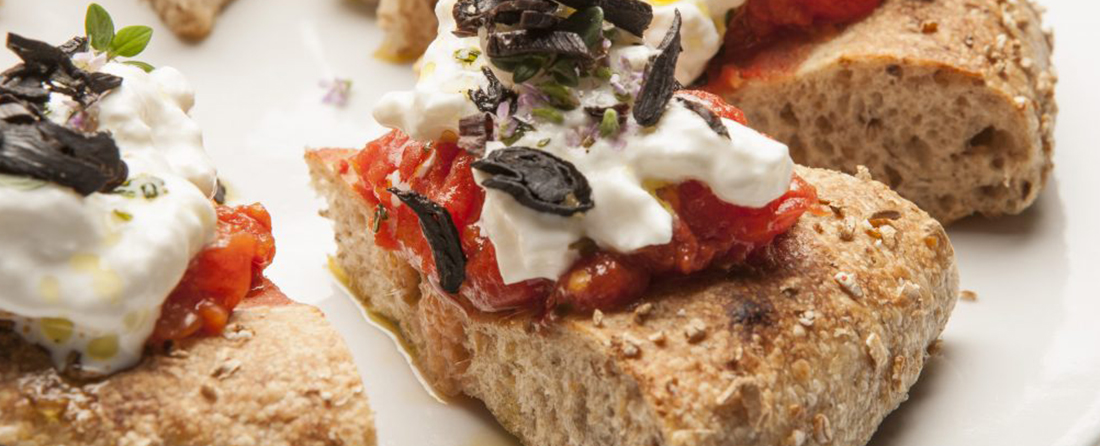
On each slice, we will place a small spoonful of warm tomato pulp, an equal amount of room-temperature burrata, a generous drizzle of aromatic pesto, and finally the Scalogno Nero di Romagna.
We will then serve without delay, wishing a sincere bon appétit to those who have accompanied us on this delicious journey!