


From the soil to active research: a new series from NeroFermento
The Science of Black Garlic – Part 1 of 8: Antioxidants
This article launches our in-depth exploration of the biological properties of black garlic, stemming from an official collaboration between NeroFermento and researchers at the University of Ferrara (published in the Journal of Agricultural and Food Chemistry). We start with the basics of cellular protection: how natural aging multiplies polyphenols and transforms the bulb into a shield against free radicals.
What gives fermented black garlic its edge?
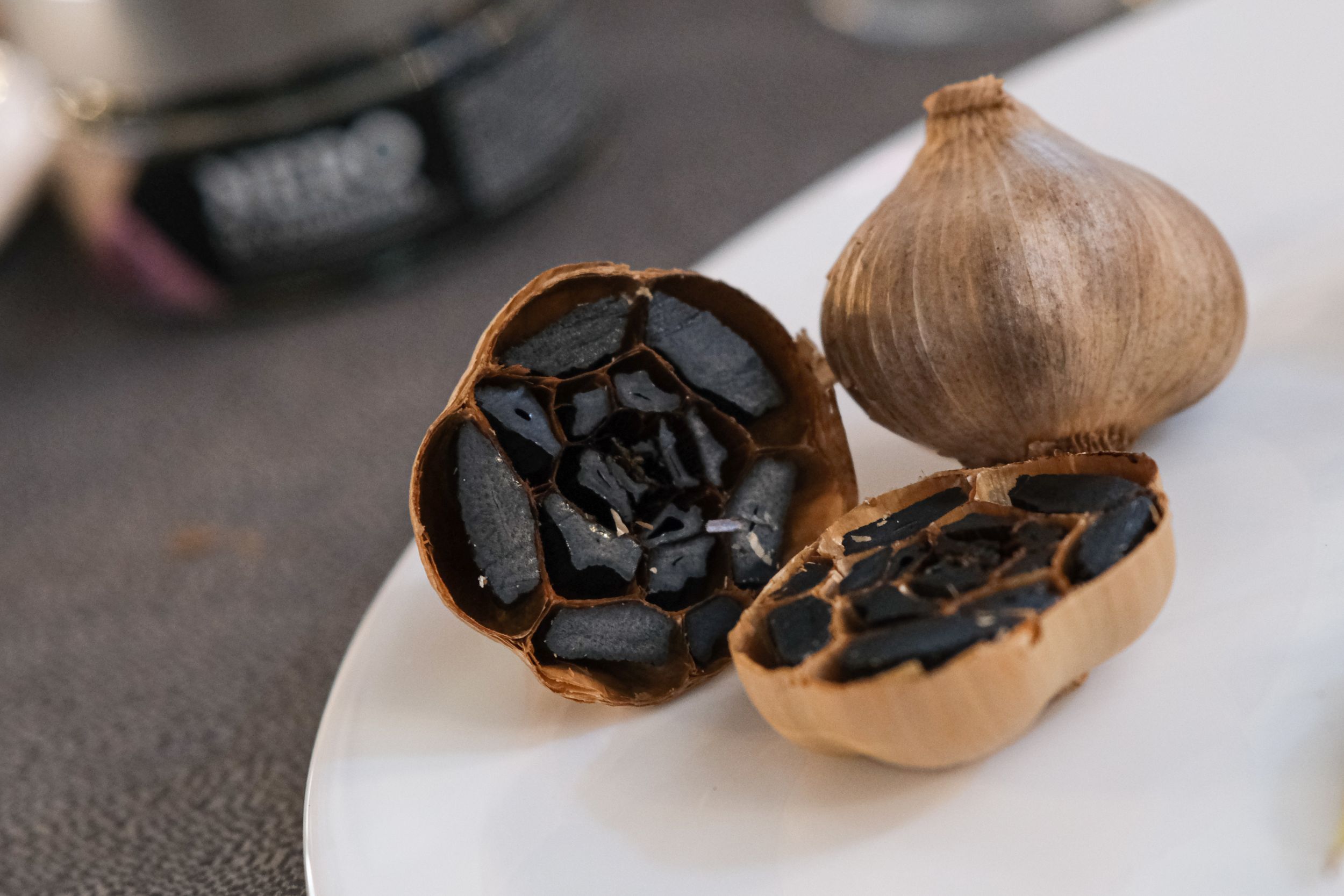
As highlighted by the study conducted by the Department of Life Sciences and Biotechnology at the University of Ferrara, thermal aging driven by the Maillard reaction radically changes the chemistry of fresh garlic. During this transformation, allicin, which is responsible for the raw bulb’s strong odor and poor digestibility, is converted into water-soluble, odorless and exceptionally stable sulfur compounds, notably S-allylcysteine (SAC) and S-allylmercaptocysteine (SAMC).
This transformation enhances the properties of black garlic that combat free radicals, with measurable results that make it markedly superior to fresh garlic:
-
Up to 3 times greater free radical scavenging capacity: Laboratory tests (in vitro) show that fermented black garlic extract has two to three times the capacity to neutralize free radicals as raw garlic.
-
Long-lasting protective action: While the protective effect of fresh garlic against lipid peroxidation (the deterioration of cell membranes) begins to decline as early as the third day, black garlic extract maintains its full antioxidant effectiveness for up to 5 consecutive days.
-
Activation of endogenous defense enzymes: In vivo studies confirm that consuming black garlic reduces oxidative stress in the liver and directly stimulates the activity of the main antioxidant enzymes produced by the body, such as superoxide dismutase (SOD), glutathione peroxidase (GPx) and catalase (CAT).
-
A surge in total polyphenols: As cellular structures break down during the thermal process, phenolic compounds increase significantly, rising from an average of 13.91 mg GAE/g in fresh garlic to peaks of 58.33 mg GAE/g in black garlic.
In other words: aging transforms garlic into a much more powerful and long-lasting “shield” than raw garlic. It not only neutralizes the free radicals that age cells up to three times more effectively, but also awakens the natural defenses already present in our bodies, offering long-lasting protection.
A daily ally for flavor and prevention
When it comes to black garlic and health, oxidative stress plays a central role: when the buildup of free radicals overwhelms our natural defenses, cells age prematurely and the risk of developing chronic diseases increases.
Regularly incorporating black garlic into your everyday cooking, taking advantage of its natural creaminess and complete lack of a pungent aftertaste, allows you to turn a simple dish into a true natural black garlic supplement. In upcoming installments of this series, we will explore other key findings from the University of Ferrara’s research, starting with its anti-inflammatory effects and immune system support.
SOURCES
Vecchi, V., Sabbioni, G., Altieri, M. T., Breveglieri, G., Costa, S., Marchetti, F., Gugel, I., Vertuani, S., & Borgatti, M. (2025). Black Garlic: Evolution of the Chemical Composition and Broad Biological Activities. Journal of Agricultural and Food Chemistry. https://doi.org/10.1021/acs.jafc.5c09705
Jeong, Y. Y., Ryu, J. H., Shin, J.-H., Kang, M. J., Kang, J. R., Han, J., & Kang, D. (2016). Comparison of Anti-Oxidant and Anti-Inflammatory Effects between Fresh and Aged Black Garlic Extracts. Molecules, 21(4), 430. https://doi.org/10.3390/molecules21040430
Kim, J. H., Nam, S. H., Rico, C. W., & Kang, M. Y. (2012). A Comparative Study on the Antioxidative and Anti-allergic Activities of Fresh and Aged Black Garlic Extracts. International Journal of Food Science & Technology, 47, 1176. https://doi.org/10.1111/j.1365-2621.2012.02957.x
Lee, Y.-M., Gweon, O.-C., Seo, Y.-J., Im, J., Kang, M.-J., Kim, M.-J., & Kim, J.-I. (2009). Antioxidant Effect of Garlic and Aged Black Garlic in Animal Model of Type 2 Diabetes Mellitus. Nutrition Research and Practice, 3(2), 156. https://doi.org/10.4162/nrp.2009.3.2.156
Choi, I. S., Cha, H. S., & Lee, Y. S. (2014). Physicochemical and Antioxidant Properties of Black Garlic. Molecules, 19(10), 16811-16823. https://doi.org/10.3390/molecules191016811