


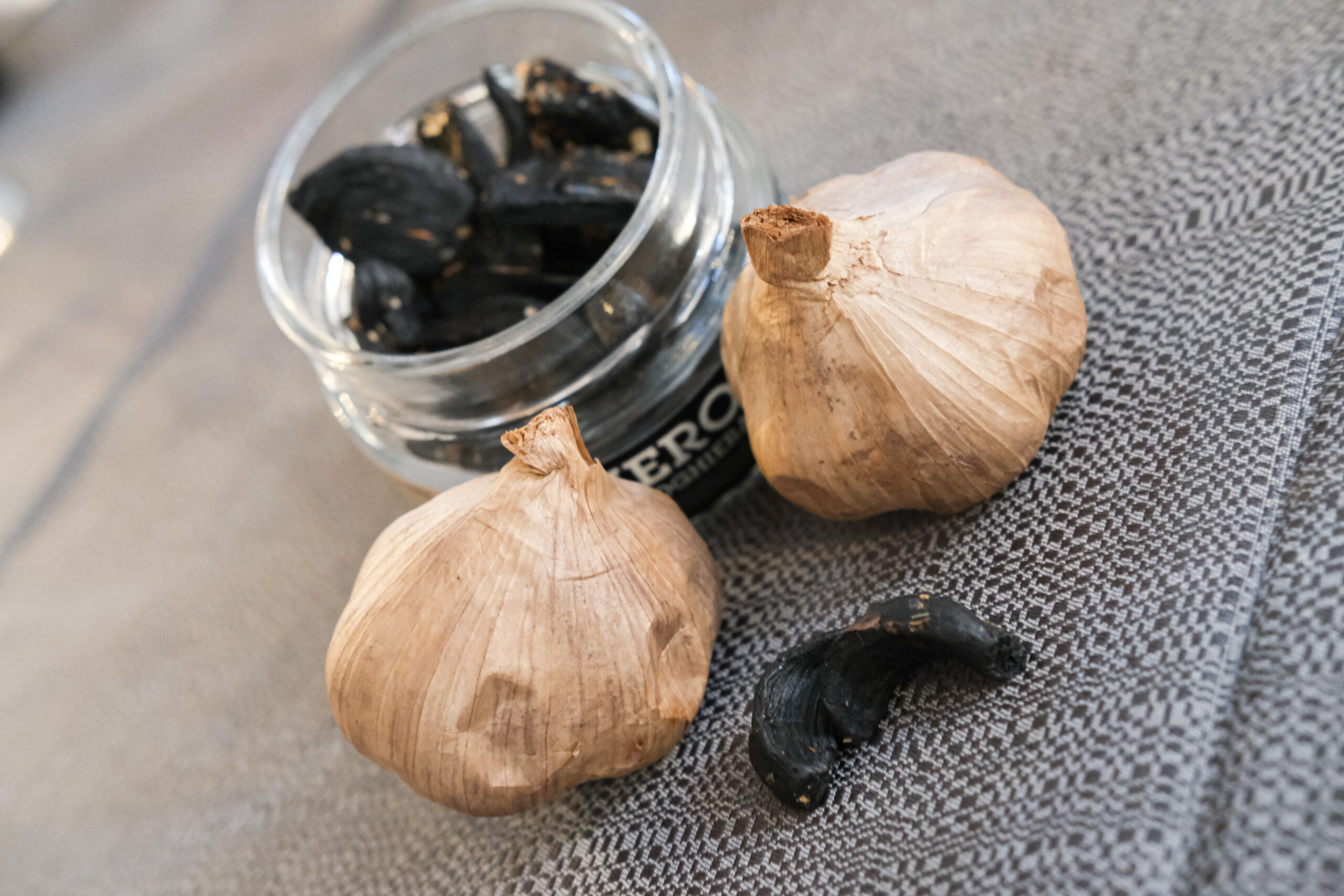
Black Garlic and Oncological Prevention: A Promise from Nature
Cancer is one of the leading causes of mortality in the world. Research has shown that black garlic, thanks to its antioxidant and anti-inflammatory propertiescan act effectively in the oncological prevention. Its bioactive compounds, such as the S-allylcysteine (SAC) and the S-allylmercaptocysteine (SAMC)are the focus of numerous scientific studies.
Oxidative stress and cancer
Oxidative stress, caused by an excess of free radicalsIt damages DNA and promotes mutations that can lead to the development of tumours. Black garlic helps neutralise free radicalsprotecting cells from damage and reducing the risk of malignant transformation [Ahmed & Wang, 2021][Park et al., 2014]..
Direct mechanisms: Apoptosis and proliferation blockade
The SAC and SAMC compounds in black garlic directly affect cancer cells via:
- Induction of apoptosis: SAC activates proteins such as Bax and caspase-3, promoting the programmed death of tumour cells [Park et al., 2014]..
- Blocking proliferation: Black garlic inhibits the PI3K/AKT and NF-κB pathways, which are crucial for the cancer cell growth [Shin et al., 2010]..
Indirect mechanisms: Inhibition of metastasis
Black garlic reduces the expression of metalloproteinases MMP-2 and MMP-9enzymes involved in the spread of cancer cells. In this way it also acts on the prevention of metastasis [Ahmed & Wang, 2021]..
Scientific evidence
Preclinical studies on cell lines of colon, stomach and breast cancer prove that theblack garlic extract reduces the proliferation of malignant cells and improves survival in animal models.
Thanks to these properties, black garlic proves to be a natural promise in cancer preventionwith potential applications in the therapeutic field as well.
✨ Learn more about the power of black garlic!
Read also our article on black garlic and inflammation or visit the our official shop to discover all the benefits.
To learn more about the benefits of thefermented black garlic, visit the section Health.
A heartfelt thank you to Dr. Valentina Vecchi for her contribution to black garlic research, to Prof. Monica Borgatti for her academic guidance and to the University of Ferrara for their constant commitment to scientific research.
SOURCES
Colín-González, A. L., Santana, R. A., Silva-Islas, C. A., Chánez-Cárdenas, M. E., Santamaría, A., & Maldonado, P. D. (2012). The Antioxidant Mechanisms Underlying the Aged Garlic Extract- and S-Allylcysteine-Induced Protection. Oxidative Medicine and Cellular Longevity, 2012(1), 907162. https://doi.org/10.1155/2012/907162
Dai, F., Chen, W.-F., & Zhou, B. (2008). Antioxidant synergism of green tea polyphenols with alpha-tocopherol and L-ascorbic acid in SDS micelles. Biochemistry, 90(10), 1499-1505. https://doi.org/10.1016/j.biochi.2008.05.007
Lee, Y.-M., Gweon, O.-C., Seo, Y.-J., Im, J., Kang, M.-J., Kim, M.-J., & Kim, J.-I. (2009). Antioxidant effect of garlic and aged black garlic in animal model of type 2 diabetes mellitus. Nutrition Research and Practice, 3(2), 156. https://doi.org/10.4162/nrp.2009.3.2.156
Pedraza-Chaverrí, J., Barrera, D., Maldonado, P. D., Chirino, Y. I., Macías-Ruvalcaba, N. A., Medina-Campos, O. N., Castro, L., Salcedo, M. I., & Hernández-Pando, R. (2004). S-allylmercaptocysteine scavenges hydroxyl radical and singlet oxygen in vitro and attenuates gentamicin-induced oxidative and nitrosative stress and renal damage in vivo. BMC Clinical Pharmacology, 4(1), 5. https://doi.org/10.1186/1472-6904-4-5
Qiu, Z., Zheng, Z., Zhang, B., Sun-Waterhouse, D., & Qiao, X. (2020). Formation, nutritional value, and enhancement of characteristic components in black garlic: A review for maximising the goodness to humans. Comprehensive Reviews in Food Science and Food Safety, 19(2), 801- 834. https://doi.org/10.1111/1541-4337.12529
Reddy, V. P. (2023). Oxidative Stress in Health and Disease. Biomedicines, 11(11), 2925. https://doi.org/10.3390/biomedicines11112925
Rice-Evans, C. A., Miller, N. J., & Paganga, G. (1996). Structure-antioxidant activity relationships of flavonoids and phenolic acids. Free Radical Biology & Medicine, 20(7), 933-956. https://doi.org/10.1016/0891-5849(95)02227-9
Zhao, L., Chen, J., Su, J., Li, L., Hu, S., Li, B., Zhang, X., Xu, Z., & Chen, T. (2013). In vitro antioxidant and antiproliferative activities of 5-hydroxymethylfurfural. Journal of Agricultural and Food Chemistry, 61(44), 10604-10611. https://doi.org/10.1021/jf403098y